Categories
Uncategorized

Members Corner: John Kromer, from our PAMily, Named SLA Fellow

A long time member of our PAMily, John Kromer, was given the wonderful news that, in recognition of all of his work for the SLA, he was named an SLA Fellow. According to the letter that informed him of his new appointment, SLA Fellows are nominated

in recognition of past and present service, as well as expected future contributions to the association and the profession. Fellows are called upon and expected to advise the association’s Board of Directors, prepare necessary documentation, and alert the membership to issues and trends warranting action. As they are expected to continue serving the association, Fellows are expected to support and promote the Core Values of SLA (leadership, service, innovation and continuous learning, results and accountability, collaboration and partnering, and a commitment to a safe and equal space for professional participation)

I had the opportunity to speak with John about his nomination, and we had a delightful conversation. He told me about his work with the SLA, which, like most of us, involved seeing a need and stepping in to fulfill that need. As a result, he was a member of many SLA committees over the years and grew to love the work that the SLA does, as well as gaining a deep knowledge of the various needs and priorities that the SLA supports. He was even awarded the PAM Achievement Award in 2022, so that should give a good idea of how much he has participated in and supported the PAMily and the SLA over the years.

Congratulations, Cheers and Celebrations to John Kromer and his new appointment!
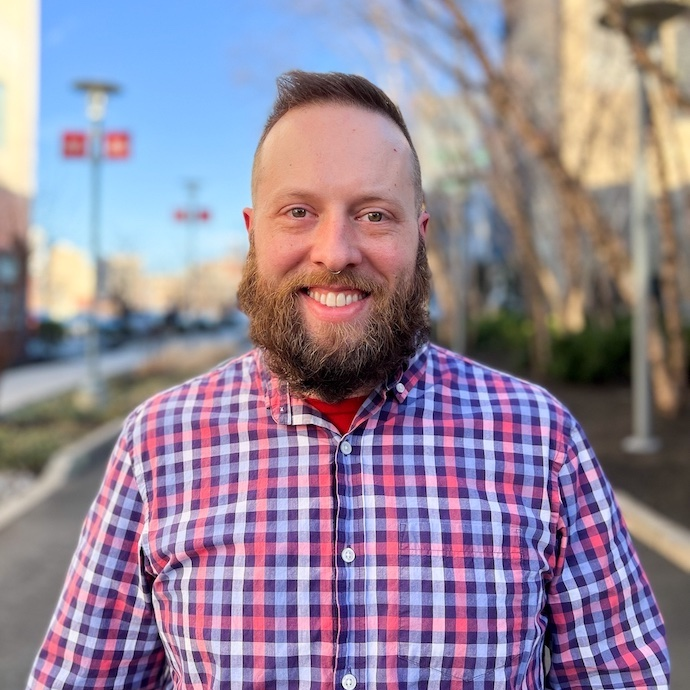
John Kromer is the Associate University Librarian for Research & Engagement at the New Jersey Institute of Technology.  He has held previous science librarian roles at Arizona State University, Brown University, and Miami University.  He holds master’s degrees in Chemistry and Library & Information Studies, both from the University of Wisconsin-Madison, and a bachelor’s degree in Chemistry and French Language & Literature from Transylvania University.  John has been particularly active in the Physics-Astronomy-Mathematics (PAM) Division of SLA, where he served as Chair-Elect/Chair/Past-Chair in 2018-2020 and received the 2022 PAM Achievement Award.  John’s research interests include electronic research notebooks, the impact of library instruction on student success, and the cost of library materials for completing assignments.  Outside of work, John plays hockey with the New York City Pride Hockey Alliance, crochets, CrossFits, and plays trombone and occasionally bassoon with the NJIT Wind Ensemble and the Montclair Community Band.

Categories
Uncategorized

Adding Skills With LaTex /Overleaf To Your Portfolio

In Fall 2024, the PAM Professional Development Committee hosted a 3-part workshop on LaTex/Overleaf for Librarians. This workshop series was designed by Sam Hansen (Institute for Mathematical and Statistical Innovation) and Alex Manchester (Stanford University).  The first session began with the basics of LaTex and using Overleaf to write LaTex code. The homework for participants was to take a document/article they already have and begin to recreate it in LaTeX, using Overleaf. They were to focus on getting it formatted nicely (with figures, lists, etc), but not worry about having it exactly match the original. Participants were encouraged to frequently consult outside resources such as (but not limited to) Google, StackExchange, and the Overleaf documentation. At the second session, Sam and Alex went into greater detail on tables and figures, style files, and other components of formatting. The homework for participants was to prepare a short (3-4min) ‘lightning’ presentation on how to do something in LaTeX/Overleaf that hasn’t been covered yet. For the third part in the series, participants presented their newly acquired skill in Overleaf, including footnotes, formatting paragraphs, columns, and accessibility. Sam and Alex completed the session with some approaches to accessibility, class files (such as dissertations), and CVs in LaTex.

The session recordings can be found here:
Session 1
https://stanford.zoom.us/rec/component-page?action=viewdetailpage&sharelevel=meeting&useWhichPasswd=meeting&clusterId=aw1&componentName=need-password&meetingId=IizmB1_oQfwdaPqvChnyBMioE9W1XrKbE0LfWPqobhlp47d-4Q2n3MT3yia4dw7f.KhCEXq9Az9nQNQ67&originRequestUrl=https%3A%2F%2Fstanford.zoom.us%2Frec%2Fshare%2Fdmlglnk_SN4rtpWKxrDWvzmqB2ztsfO4lpTgZpAmGHbFSh0qG718FRVEOt65QfR-.DYL73bzDgCVYRqnj%3FstartTime%3D1727110444000, password: AmH5Q=aK

Session 2
https://stanford.zoom.us/rec/component-page?action=viewdetailpage&sharelevel=meeting&useWhichPasswd=meeting&clusterId=aw1&componentName=need-password&meetingId=nEs2r0tL627ROSvd-ArtikX_sU8ukfNl6DKY-7BQgvYc9-cZQ08dDyhr7K0Em8fF.pWkFqp7xt5CdrHCR&originRequestUrl=https%3A%2F%2Fstanford.zoom.us%2Frec%2Fshare%2FTMBD1TfjEZ_jv3bxpuvj-IdioXKZedn9BJTFPUdKa24PnxapWXsocUrd7DkDjzSm.mvNUT3T-UaOPnjn2, password: 0&Lid=ef

Session 3
https://stanford.zoom.us/rec/share/fWNBK62F6nPEWSnEpAi5CxMN5v8gRSdSRmqiHtp_643LzRQ5DZN0VQe450FcNkbk.xYuyWXL-tOk-D2BG?startTime=1731694572000, password: %8F^%vtN

In the Spring, we are hoping to do a 4th session about teaching LaTex and Overleaf. More info to come! 

Does PAM have a great Professional Development Committee, or what?? I know I can’t wait for the next LaTex / Overleaf session!

Categories
Uncategorized

2025 SLA Conference: Creative Transformation

Check out the information for the 2025 SLA Conference: Creative Transformation. The conference is being hosted June 7 – 10 at the University of Pittsburgh. Presentations, posters and events are still being planned, but we know that the tracks are:

• Data Science & Research • Leadership & Management • Innovative Technology • Marketing & Competitive Intelligence • Knowledge & Record Management •

The conference is shaping up to be a fantastic chance to network and learn, so make sure you get your registration in and your reservations made before it’s too late!

Categories
Uncategorized

2025 is the International Year of Quantum Science and Technology

The United Nations General Assembly proclaimed 2025 to be the International Year of Quantum Science and Technology. This year was chosen because, 100 years ago, quantum mechanics was developed.

Find out more information about events and ways to participate with the celebrations at Quantum.gov, the home of the government’s National Quantum Initiative.

The journal Physics Physique Fizika published a number of important articles on Quantum Science and Technology in the latter half of the 1960s. The American Physical Society (APS) has made these issues openly available if you would like to read through them. The APS also published a great article about the Year of Quantum in Physics Magazine, which you can read here.

Categories
Uncategorized

LISA 10 Conference: Research, Equity and Access in the Age of AI

We invite all those interested in Library and Information Services in Astronomy (LISA) to mark their calendars to attend LISA 10 in Santiago de Chile. LISA 10, Research Equity and Access in the Age of AI, will take place the week of Mon, 03 Nov – Fri, 07 Nov 2025 and will provide participants the opportunity to engage with fellow librarians, archivists, data specialists, bibliographers, publishers, documentalists, experts on evolving technologies, and scientists. The LISA conference series aims to provide a platform to discuss the state-of-the-art for information maintenance, retrieval, metrics, preservation, scholarly publishing, and information systems.

The conference will be held in-person at the European Southern Observatory (ESO) premises in Santiago, Chile, with remote participation available via MS Teams. Registration and abstract submission will open in April.

Remote participants are equally encouraged to submit their abstracts for consideration. Both presentations and digital posters are welcome and will be organized around the following themes:

• Using AI/ML/LLMs Responsibly Topics on current or potential application of AI/LLMs/ML at your institution or in your information service community, including opportunities and challenges

• Research Equity, Inclusiveness & Access Ensuring equity with perspectives from around the globe

• Stewarding Astronomical Knowledge Best practices in traditional and data archives, documentation, and knowledge transfer and representation

• Assessing the Impact of Research Sharing insights into tools, platforms, documentation and the ?why? of bibliometrics. Presentations on researcher/staff, institutional, and observatory metrics are encouraged

• The Future of Multidisciplinary Research Current and future expansion of science disciplines and SciX; changes to where and how astronomy gets published; diversity of research communities and media beyond the traditional journal article

• Enabling Open Science Topics on data curation, data management and open software; ensuring reproducibility and access to others

• Navigating Open Access How changes in publishing models are impacting libraries and their customers; publishing challenges at your institution; topics on affordability and credibility of journals

•The Changing Roles of Astronomy Libraries Additional topics, such as:

o   changing role of special libraries, connecting users to resources and managing collections;

o   changing demands on libraries, such as research/data support;

o   role in organizing conferences or publishing conference proceedings;

o   navigating copyright law;

o   organizing training for research skills like proposal writing/Overleaf, etc.

General questions can be directed to LISA10@eso.org<mailto:LISA10@eso.org>

We look forward to receiving your abstracts soon and to seeing you in Santiago.

LISA 10 SOC & LOC

Categories
Uncategorized

STELLA 2024 Virtual Unconference December 13, 2024

The 2024 Stella Unconference is taking place VIRTUALLY on Friday, December 13, 2024. This free event welcomes current or aspiring science, technology, engineering and medical/health librarians and those interested in STEM librarianship. In the Unconference spirit, YOU will drive the agenda and determine what discussions and breakouts will take place. It’s a great chance to discuss and learn about current topics relevant to STEM librarianship.

IF you are interested in receiving updates about the Unconference, please follow the instructions on how you can subscribe to the STELLA Listserv at https://stellaunconference.com/about/ . (This is a relatively quiet list).

The latest information that was sent out is:

  • registration is open through Friday, November 15
  • voting is open for discussion sessions
  • a call is out for presenters, lightning talks and poster presentation
  • a second call is out for discussion session Facilitators (welcome presenters, run the Zoom room, ask submitted questions)

Please see the registration form to submit your information for the session vote, the call for presenters, and the call for session facilitators

STELLA Unconference Agenda – Schedule for Friday, December 13th (All times in Eastern Time):

11:00-11:30am Coffee Break & Welcome

11:30am-12:45pm Session 1

12:45-1:00pm Break

1:00-2:00pm Lightning Talks and Posters

2:00-2:15pm Break

2:15-3:30pm Session 2

3:30-4:00pm Close-Out

If you have any questions, please feel free to contact the STELLA 2024 Organizing Committee at stellaunconference@gmail.com.

Categories
Uncategorized

Lots of Great Discussions Were Had at the SLA 2024 and the Summer Math Roundtables

SLA 2024 Math Roundtable

The Math Roundtable at the SLA 2024 conference was a plenary discussion. We covered a number of great topics, which are detailed below.

Accessible HTML for Math: We discussed what tools were available to convert mathematics papers to an HTML format that would be accessible for use with screen readers. The American Mathematical Society (AMS) noted they had developed some tools to make math documents accessible. They are hoping to make them more publicly available in the future.

ArXiv has their own LaTex to HTML converter, and they are hosting an online forum on accessibility soon. They will make an announcement on PAMnet when they have the details ready, so look out for that.

Artificial Intelligence and Math: We talked about AI training on math. A representative from ArXiv said there was evidence that AI models had been trained on ArXiv.

E-Books Versus Print Use of Math Materials: The AMS reported that 40% of their book sales are e-books. Also, 75% of their journal subscriptions are online only. The Society for Industrial and Applied Mathematics (SIAM) noted that their digital sales also outstrip print sales for books.

Author IDs Using ORCID: The discussion involved the use of ORCID by math researchers. Librarians at the University of Rochester said that they help populate their researchers’ ORCIDs for them. Various publishers reported that they have seen inconsistent use of ORCID from authors. Mathematical Reviews said that they focus more on using MRID instead of ORCID. SIAM doesn’t mandate that authors have an ORCID, but they encourage authors to get one. It was also noted that sometimes mathematicians use a new ORCID when they move to a new institution.

AMS versus EBSCOhost re: the MathSciNet Interface: The discussion revolved around teaching the two interfaces to students. Some librarians said that they teach undergraduate students about the EBSCOhost interface because the students are already used to using EBSCOhost for other databases.

Summer 2024 Math Roundtable

An online Math Roundtable was hosted over ZOOM late in the summer. The discussion was active and covered a number of topics.

A question was posed about relocating Lecture Notes in Mathematics to storage if they have not circulated in 10 years.

Next, the IMU Permissions report was discussed. The report may be viewed at https://www.mathunion.org/activities/ad-hoc-committee-permissions-cop .

After the report discussion, there was a proposal that the MathSciNet and the Mathematics Genealogy Project could link to Open Access theses & dissertations as well as ProQuest Dissertations. More and more schools are making their theses & dissertations freely available online, so being able to access the documents directly from the two databases would save time and effort. It was suggested that perhaps MathSciNet might be interested in doing a pilot with a select group of PAM people.

Another item brought up was an interest in learning LaTex and learning how to teach others to use it.

Tyler Kane, AMS, speaking about mathematics and accessibility, said, “I’d love to get Peter Krautzberger in a PAM session to discuss math and accessibility. We had him do a webinar https://www.youtube.com/watch?v=P2y-4bGBwec on how this applies to one aspect of AMS publications, Mathviewer, but he is also a great source of information on development. The asterisk here is that he is pretty invested in projects that he has worked on, but he is very invested in this topic.”

Finally, a great article was brought up on the trending topic of Data Sharing: Making Mathematical Research Data FAIR: Pathways to Improved Data Sharing. (2024) Scientific Data, 11 (1), art. no. 676 https://doi.org/10.1038/s41597-024-03480-0

Categories
Uncategorized

Members’ Corner: New Marketing Director for Science/AAAS

Sharice Collins is delighted to announce that she started a new position as the Marketing Director for Science/AAAS. In her new role, she is overseeing global sales and marketing activities for the Science family of journals, Science Careers, and Science Custom Publishing

Sharice said, “I am humbled to be a part of this prestigious organization whose mission and values so closely align with my own.  I am especially excited to continue to work with the library community, nurturing the essential librarian/publisher relationship.” 

A longtime PAM member, supporter, and 2015 PAM Achievement Award winner, Sharice is looking forward to maintaining her bonds with the PAMily and is grateful for the support and positivity she received from the library community as she made the professional transition to Science/AAAS.

Cheers and Celebrations from the PAMily for Sharice Collins!